IPFS
knowledge should be freely accessible to all
Institute for Plasma Focus Studies
Internet Workshop on Numerical Plasma Focus
Experiments
Module2;
(Follow the instructions in the following notes. You may also wish to refer to
the supplementary notes part2supplementary.htm
Summary:
For this
module we fit model parameters so that computed current waveform matches
measured current waveform.
First we
configure the UPFL for PF1000 operating in Deuterium; using trial model
parameters. We fire a shot. We do not
know how good our results are without a reference point; ie
some comparison with experimental results.
A total
current waveform of the PF1000 has been published; we have it in digitized
form.
To
ensure that our computed results are comparable to experimental results, the key step is to fit model parameters, by adjusting the model parameters until the
computed total current trace matches the measured total current trace.
To do this,
we add a Sheet 2 to our numerical plasma laboratory; place the digitized data
of the measured trace in Sheet 2 and plot this trace in a chart. Next we plot the computed current waveform in
the same chart. The model parameters are varied; at each variation the focus is
fired, and the computed current waveform is compared with the measured
waveform. The process is continued until the waveforms are best matched. A good
match gives confidence that the computed results (trajectories, speeds,
temperature, neutron and radiation yields etc) are
comparable with actual experimental results.
After the
guided fitting of the PF1000, we have a self exercise
to fit the Chilean PF400.
We then
tabulate important results of both machines, and do a side-by-side comparison of a big vs a small plasma focus
to obtain important insights into scaling laws/rules of the plasma focus
family.
Steps: (a) To configure the
code for the PF1000 using trial model parameters
(b) To place a published PF1000 current
waveform on Sheet 2.
(c)
To place the computed current waveform on Sheet 2 in the same figure
(d)
To vary the model parameters until the two waveforms have the best match.
(e) Exercise 2: Tabulate results
for PF1000 obtained in our numerical experiment.
(f) Exercise 3; participants to
fit the PF400 and tabulate the results for PF400 side by side with the results
for PF1000, for a comparative study.
The material:
You need File7RADPFV5.15b (called
File7) for the following work. Copy and Paste a copy on your Desktop. You also
need the files PF1000data.xls, PF400data.xls
and compareblank.xls for this
session. Use the cursor to drag each file onto your desktop.
(a) Configure the code for PF1000
Double
click on File7 (Excel logo File7RADPFV5.15 on your Desktop).
Security
pop-up screen appears.
Click on enable macros
The worksheet opens.
[Type in cell B3: PF1000; for identification purposes.]
[The PF1000, at 40kV, 1.2 MJ full capacity,
is one of the biggest plasma focus in the world. Its 288 capacitors have a
weight exceeding 30 tonnes occupying a huge hall. It
is the flagship machine of the ICDMP, International Centre for Dense Magnetised Plasmas.]
We
use the following bank, tube and operating parameters:
Bank: Lo=33.5
nH, Co=1332 mF, ro=6.3mOhm
Tube: b=16
cm, a=11.55 cm, zo=60 cm
Operation: Vo=27kV,
For this exercise we do not know
the model parameters. We will use the trial model parameters recommended in
the code (See cells P9-V9)
Model: massf=0.073,
currf=0.7, massfr=0.16, currfr=0.7; our first try.
Configuring: Key in the following:
A5 B5 C5 D5 E5 F5
33.5
1332 16 11.55 60 6.3
Then A9 B9 C9 D9 E9
27 3.5 4 1 2
Then A7 B7 C7 D7
0.063
0.7 0.16 0.7
for first try
Or follow the guide in A4-F4, to key in A5-F5 for the
relevant parameters.
Fire a shot: Place the cursor in any blank non-active
space, e.g. G8. (point the cursor at G8 and click the mouse). Press ‘Ctrl’ and ‘A’. (equivalent to firing a
shot)
The
program runs and results are displayed in columns and also in figures.
Is our simulation any good? Not if there is no reference point!!
To
assess how good our simulation is, we need to compare our computed current
trace with the measured current trace, which has been published.
Note
that at this point: File7 contains computed data for PF1000 with the trial
model parameters of: massf=0.073,
currf=0.7, massfr=0.16, currfr=0.7
(b) To place a published PF1000 current
waveform on Sheet 2
(i)
The PF1000 current waveform is in the file
PF1000data.xls. You now want to place this data into File7 as Sheet2. With
File7 open, click on ‘File’ tab; drop down appears, click on ‘Open’. Look in:
Desktop; select PF1000data.xls; double click to open this file. Click on ‘Edit’
tab; select ‘Move or Copy Sheet’. A window pops out; ‘Move selected sheets To
book’; select ‘File7RADPF13.9b.xls. ‘Before Sheet:’ select ‘(move to end)’.
Click ‘OK’. You have copied PF1000data.xls into File7 as Sheet1(2); you might
like to rename Sheet1(2) as Sheet2.
(ii) Chart
the measured current waveform: The
measured current waveform is already charted in Sheet2. You may adjust the size
and position of the chart for your preferred viewing.
(c)
To place computed current waveform on Sheet 2 in the same chart
To place the computed current waveform on
the same chart: Position the cursor on the chart containing the measured
current waveform. Now right
click. Pop-up appears. Select ‘Computed Current in kA’ in
the name box.
In the next steps we will place the
computed current data from Sheet 1 into this same chart in Sheet 2, by the
following procedures. Place the cursor in the box against ‘X values’ by
clicking. Then type in the following string: “=sheet1!$a$20:$a$6000” [without the quotation marks]. Next click in
the box against ‘Y Values’ and type in the following: “=sheet1!$b$20:$b$6000” [without the quotation marks]. Click button
‘OK’.
The pink trace (see figure below) is the
computed current trace transferred from Sheet 1 (where the time data in us is
in column A, from A20-Aseveralthousand; and corresponding computed current data
in kA is in column B, from B20 to B severalthousand).
We are selecting the first 5980 points (if that many points have been
calculated) of the computed data; which should be adequate and suitable.
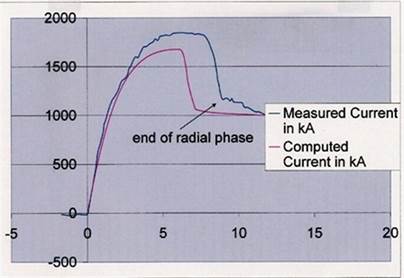
Comparison of traces: Note that there is
very poor matching of the traces; using the first try model parameters.
(d) Vary model
parameters to obtain matching of computed vs measured
current traces. (bank,
tube & operating parameters all
given correctly)
(i) First fit
the axial phase:
[suggestion: read part2supplementary.doc pg 2
bottom para ‘First step is fitting axial phase’.]
From the comparison chart on sheet 2,
We note:
that the computed
current dip comes much too early;
that the computed
current rise slope is only very slightly low;
that the computed current maximum is too low.
All these 3 observations are consistent
with a possibility that the axial speed is too fast; which would cause the
radial phase to start too early. Too high an axial
speed would also cause too much loading on the electrical circuit (similar to
the well known motor effect) as the quantity [0.5*dL/dt=0.5x L’*dz/dt] is a dynamic resistance loading the circuit
during the axial phase; here the
inductance per unit length L’=(m/2p)*ln(b/a)
This too high speed would also lower the peak current.
To reduce the axial speed, we could increase the
axial mass factor. We note that the axial phase ends too early by some 20%;
indicating the axial speed is too fast by 20%.
In the
plasma focus (as in pinches, shocks tubes and other electromagnetically driven
plasma devices) speed~density^0.5. So the correction we need is to increase the
axial mass factor by 40%. So try an axial mass factor of 0.073x1.4~ 0.1.
We toggle to Sheet 1 by clicking on ‘Sheet
1’ (just below the worksheet).
Click on cell A7, and type in 0.1.
Fire the focus by pressing Ctrl+A.
Program runs until complete, and results
are presented.
Note TRadialStart
(H16) has increased some 0.7 us.
Toggle to Sheet 2 (ie
click on Sheet 2 just below work sheet).
Note that the computed current dip is now
closer to the measured in time (still short by some 10%; reason being that
increasing axial mass factor reduces the speed which in turn causes a reduced
loading. This increases the current which tends to increase the axial speed so
that our mass compensation of 40% becomes insufficient). The value of the
computed peak is also closer to the measured. So we are moving in the right
direction!
But still need to move more in the same
direction. Next try axial mass factor of 0.12. Toggle to Sheet 1, type 0.12 in
A7. Fire. Back to Sheet 2. Note
improvement in all 3 features.
In similar fashion, gradually increase the
axial mass factor. When you reach 0.14 you will notice that the computed
current rise slope, the topping profile, the peak current and the top profile
are all in good agreement with the measured. The computed trace agrees with the
measured up to the start of the dip. Note that the axial model parameters at
this stage of agreement are: 0.14 and 0.7. You may wish to try to improve
further by making small adjustments to these parameters. Or else go on to fit
the radial model parameters.
(ii) Next, fit
Radial phase:
Note that the computed current dip is not
steep enough, and dips to too low a value. This suggests the computed radial
phase has too high a speed. Try increasing the radial mass factor (cell C7),
say to 0.2. Observe the improvement (dip slope becomes less steep) as the
computed current dip moves towards the measured.
Continue making increments to massfr (cell C7). When you have reached the massfr value of 0.4; it is becoming obvious that further
increase will not improve the matching; the computed dip slope has already gone
from too steep to too shallow, whilst the depth
of the dip is still excessive.
How to raise the
bottom of the dip? Here we suppose the following scenario:
Imagine if very
little of the current flows through the pinch, then most of the total current
will flow unaffected by the pinch. And even if the pinch were a very severe
one, the total current (which is what we are considering here) would show
hardly a dip. So reducing the radial current fraction, ie
currfr (or fcr)
should reduce the size of the dip.
Let us try 0.68 in cell D7. Notice a
reduction in the dip. By the time we go in this direction until currfr is 0.65, it becomes obvious that the dip slope is
getting too shallow; and the computed dip comes too late.
One possibility is to decrease massfr (which we note from earlier will steepen the dip
slope); which however will cause the dip to go lower; and it is already too
low.. Another possibility is to decrease the axial phase massf,
as that will also move the computed trace in the correct direction.
Try a slight decrease in massf, say 0.13.
Note that this change aligned the dip
better but the top portion of the waveform is now slightly low, because of the
increased loading on the electrical circuit by the increase in
axial speed. This suggests a slight
decrease to circuit residual resistance ro
( or changes to Lo or Co; fitting those could be tricky,
and we try to avoid unless there are strong reasons to suspect these values).
Easier to try lowering ro first. Try changing ro
to 6.1 mW.
The fit is quite good now except the
current dip could be steepened slightly and brought slightly earlier in time.
Decrease massfr, say to 0.35. The fit has improved,
and is now quite good, except that the dip still goes too low. At this stage we
check where we are at.
Toggle to sheet 1. Note from sheet 1 that
the radial phase ends at 9.12 ms.
Back to sheet 2.
Observe (using cursor) that the point 9.12
is not at the point where the computed (pink curve) dip reaches its inflection
point; but some 0.02 ms
before that point. (see fig below)
So we note that the computed curve agrees
with the measured curve up to the end of the radial phase with a difference of
less than 0.02MA out of a dip of 0.66MA (or 3%).
The fitting has already achieved good
agreement in all the features (slopes & magnitudes) of the computed and
measured total current traces up to the
end of the radial phase.
Do not be
influenced by agreement, or disagreement of the traces beyond this end point.
The best fit?
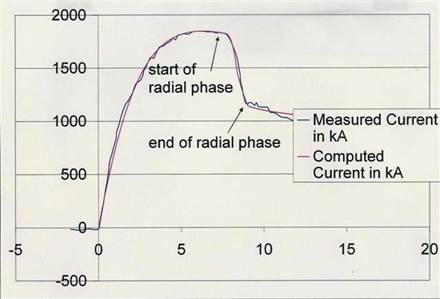
So we have confidence that the gross
features of the PF1000 including axial and radial trajectories, axial and
radial speeds, gross dimensions, densities and plasma temperatures, and neutron
yields up to end of radial phase may be compared well with measured values.
Moreover the code has been tested for
neutron and SXR yields against a whole range of machines and once the computed
total current curve is fitted to the measured total current curve, we have confidence
that the neutron and SXR yields are also comparable with what would be actually
measured.
[Having said that, those of you who have some
experience with the plasma focus would note that at the end of the radial
phase, some very interesting effects occur leading to a highly turbulent
situation with occurrence, for example, of high density hot spots. These
effects are not as yet modeled in the code. Despite this drawback, the
postulated beam-target neutron yield mechanism seems able to give estimates of
neutron yield which broadly agree with the whole range of machines. For
example, the neutron yield computed in this shot of 8.6x10^10 is in agreement
with the reported PF1000 experiments.]
(e) Exercise 2:
Fill in the following:
Q1: My best fitted model parameters for
PF1000, 27kV 3.5 Torr Deuterium are:
fm= fc= fmr= fcr=
Q2: Insert an image of the discharge
current comparison chart in Sheet 2 here.
Q3
|
Fill up the following table. Use the file compareblank.xls for this purpose. |
|
|
||||||||
|
|
|
|
|
|
|
|
|
|
||
|
Parameter |
|
PF1000 |
|
|
|
|
|
|||
|
|
|
|
( at
27kV 3.5 Torr D2) |
|
|
|
||||
|
Stored Energy Eo in kJ |
|
|
|
|
|
|
||||
|
Pressure in Torr, |
|
|
|
|
|
|
|
|||
|
Anode radius a in cm |
|
|
|
|
|
|
|
|||
|
c=b/a |
|
|
|
|
|
|
|
|
||
|
anode length zo in cm |
|
|
|
|
|
|
||||
|
final pinch radius rmin
in cm |
|
|
|
|
|
|
||||
|
pinch length zmax in
cm |
|
|
|
|
|
|
||||
|
pinch duration in ns |
|
|
|
|
|
|
|
|||
|
rmin/a |
|
|
|
|
|
|
|
|
||
|
zmax/a |
|
|
|
|
|
|
|
|
||
|
Ipeak in kA |
|
|
|
|
|
|
|
|||
|
Ipeak/a in kA/cm |
|
|
|
|
|
|
|
|||
|
S=(Ipeak/a)/(Po1/2)(
kA/cm)/Torr1/2 |
|
|
|
|
|
|
||||
|
Ipinch in kA |
|
|
|
|
|
|
|
|||
|
Ipinch/Ipeak |
|
|
|
|
|
|
|
|||
|
Peak induced voltage in kV |
|
|
|
|
|
|
||||
|
peak axial speed in cm/us |
|
|
|
|
|
|
||||
|
peak radial shock speed cm/us |
|
|
|
|
|
|
||||
|
peak radial piston speed cm/us |
|
|
|
|
|
|
||||
|
|
|
|
|
|
|
|
|
|
||
|
peak temperature in 10^6K |
|
|
|
|
|
|
||||
|
neutron yield in 10^6 |
|
|
|
|
|
|
|
|||
|
|
|
|
|
|
|
|
|
|
||
[After filling, save this Excel sheet You will use the
same Excel sheet to fill in the results for PF400 which is the subject of the
next exercise.]
(f) Exercise 3:
Participant to fit computed current to measured current waveform of PF400 (bank, tube and
operating parameters all correctly given)
In Modulek 1, we worked with the Singaporean NX2; a 3kJ neon
plasma focus designed for SXR lithography. This week we worked with the Polish
PF1000, one of the largest plasma focus (MJ) in the world. You are now given
data for the PF400, a small sub-kJ plasma focus operated in
Given: the current waveform data of the
PF400, digitized from a published waveform. The data is in the file PF400data.xls.
Your job: is to fit model
parameters until the computed current waveform matches the measured waveform.
Some guidance is given below.
Suggested steps to
fit PF400:
Copy a clean copy of File7RADPF05.14.xls
(called File7) from your Reference folder to your Desktop. Open File 7.
Copy PF400data.xls into Sheet2 of File7.
The measured waveform is already pre-charted
Transfer
computed current data from Sheet 1 onto Sheet 2; using
strings: “=sheet1!$a$20:$a$6000”
[without the quotation marks] &: “=sheet1!$b$20:$b$6000”
[without the quotation marks]. No trace of computed current appears yet, since
we have not yet ‘fired’ PF400.
Write down the bank, tube and operating
parameters (from the table in the lower part of the page, NOT from the top
line, which contains some nominal values). Toggle to Sheet 1.
Configure
the Universal Plasma Focus:
Key in the following bank and tube
parameters and the operating parameters.
|
Lo(nH) |
Co(uF) |
b(cm) |
a(cm) |
zo(cm) |
ro(mohm) |
|
40 |
0.95 |
1.55 |
0.6 |
1.7 |
10 |
|
MASSF |
CURRF |
MASSFR |
CURRFR |
Model
Parameters |
|
|
|
|
|
|
|
|
|
Vo(kV) |
|
MW |
At
No. |
At1;Mol2 |
Operation
Parameters |
|
28 |
6.6 |
4 |
1 |
2 |
|
Key in the first try model parameters; [scroll a little to the right and use the
suggested parameters for the UNU ICTP PFF, cells T9-V9].
Fire
PF400; and see the comparative results by toggling to Sheet
2.
Fitting the
computed current waveform to the measured waveform:
Suggested
first steps:
Fit the axial region by small adjustments to fm
and fc, where necessary. In fitting the axial phase, the more
important region to work on is the later
part of the rising slope and the topping profile towards the end of the axial
phase. So each time you should note the position of the end of the axial
phase from Sheet 1 and locate that position on the Chart in Sheet 2, using the
cursor.
Final
steps: When you have done the best for the axial phase up to
the end of the axial phase, then proceed to fit the radial phase. Tip: The dip
for the PF400 is not very dramatic. Enlarge the trace so the rollover and the
dip can be more clearly compared.
(f) Exercise 3:
Fill in the following, copy and paste and
e-mail to me by 26 April 2008.
Q1: My best fitted model parameters for
PF1000, 27kV 3.5 Torr Deuterium are:
fm= fc= fmr= fcr=
Q2: Insert an image of the discharge
current comparison chart in Sheet 2 here.
Q3: Complete the Excel Sheet which you
started in the last Exercise; to compare a BIG (~500kJ) plasma focus with a
small one (~400J). As you fill up, note particularly each group of ratios (each
group is denoted by a different colour). Note
particularly the order of magnitude of the ratios. [use the Excel sheet, rather than this table].
The ratios below were calculated from the
actual PF1000 and PF400 results; and left here as a check for you. Calculate
your own ratios from your own results. At the end of the exercise save this
Excel Sheet as PFcomparison.xls. It
will be used again next week.
|
Make up the following table comparing a BIG plasma focus
with a small one. |
|
|
|
|||||||||||||||||||
|
|
|
|
|
|
|
|
|
|
|
|||||||||||||
|
Parameter |
|
PF1000 |
|
Ratio |
PF400 |
|
|
|
||||||||||||||
|
|
|
|
( at
27kV 3.5 Torr D2) |
PF1000/PF400 |
(at
28kV 6.6 Torr D2) |
|
|
|||||||||||||||
|
Stored Energy Eo in kJ |
486 |
|
1313 |
0.37 |
|
|
|
|||||||||||||||
|
Pressure in Torr, |
|
3.5 |
|
0.53 |
6.6 |
|
|
|
||||||||||||||
|
Anode radius a in cm |
|
11.55 |
|
19.3 |
0.6 |
|
|
|
||||||||||||||
|
c=b/a |
|
|
1.39 |
|
0.54 |
2.6 |
|
|
|
|||||||||||||
|
anode length zo in cm |
60 |
|
35.2 |
1.7 |
|
|
|
|||||||||||||||
|
final pinch radius rmin
in cm |
|
|
26.7 |
|
|
|
|
|||||||||||||||
|
pinch length zmax in
cm |
|
|
22.2 |
|
|
|
|
|||||||||||||||
|
pinch duration in ns |
|
|
|
53 |
|
|
|
|
||||||||||||||
|
rmin/a |
|
|
|
|
1.4 |
|
|
|
|
|||||||||||||
|
zmax/a |
|
|
|
|
1.16 |
|
|
|
|
|||||||||||||
|
Ipeak in kA |
|
|
|
14.6 |
|
|
|
|
||||||||||||||
|
Ipeak/a in kA/cm |
|
|
|
0.76 |
|
|
|
|
||||||||||||||
|
S=(Ipeak/a)/(Po1/2)(
kA/cm)/Torr1/2 |
|
|
1.05 |
|
|
|
|
|||||||||||||||
|
Ipinch in kA |
|
|
|
9.64 |
|
|
|
|
||||||||||||||
|
Ipinch/Ipeak |
|
|
|
0.65 |
|
|
|
|
||||||||||||||
|
Peak induced voltage in kV |
|
|
2.4 |
|
|
|
|
|||||||||||||||
|
peak axial speed in cm/us |
|
|
1.24 |
|
|
|
|
|||||||||||||||
|
peak radial shock speed cm/us |
|
|
0.48 |
|
|
|
|
|||||||||||||||
|
peak radial piston speed cm/us |
|
|
0.48 |
|
|
|
|
|||||||||||||||
|
|
|
|
|
|
|
|
|
|
|
|||||||||||||
|
peak temperature in 10^6K |
|
|
0.19* |
|
|
|
|
|||||||||||||||
|
neutron yield Yn in
10^6 |
|
|
81920 |
|
|
|
|
|||||||||||||||
|
|
|
|
|
|
|
|
|
|
|
|||||||||||||
|
Measured Yn in 10^6:
range |
(2 - 7)E+03 |
|
|
0.9-1.2 |
|
|
|
|||||||||||||||
|
Measured Yn in 10^6
:highest |
2.0E+04 |
|
|
|
|
|
|
|||||||||||||||
|
Note: ratios in
orange: values are of the order of 1; ratios
in blue: values are of the order of (ratio of
anode radii) |
|
||||||||||||||||||||
|
or (ratio of Ipeak);
ratio of temperature (orange*) is a special case, because of the
difference in values of c. |
|
||||||||||||||||||||
|
[These points are worth thinking
about; with reference to the file on the Theory of the Lee model, |
|
|
|||||||||||||||||||
|
available from http://www.plasmafocus.net/ |
|
|
|
|
|
||||||||||||||||
|
Look especially at the sections
on the scaling parameters of the axial and radial phases] |
|
|
|
||||||||||||||||||
|
|
|
|
|
|
|
|
|
|
|
|||||||||||||
|
This table summarises the results of our numerical
experiments for Week 2 of the course. |
|
|
||||||||||||||||||||
|
It could be the start of a compilation
covering all focus machines for which measured current traces are available. |
||||||||||||||||||||||
|
We could then use the tabulation for several uses
including the following: |
|
|
|
|||||||||||||||||||
|
Think of scaling rules, laws: |
|
|
|
|
|
|
|
|||||||||||||||
|
1. How
does rmin, zmax,
and pinch duration, scale primarily with anode radius 'a'? Should there be a
relationship? |
||||||||||||||||||||||
|
2. How does the (pinch volume*pinch duration) scale with
'a'? |
|
Should
there be a relationship? |
|
|||||||||||||||||||
|
3. What is the significance of the Speed Factor S? |
|
|
|
|
|
|
||||||||||||||||
|
[hint: speed factor S is a measure of the
axial speed; it is also a measure of the energy per unit mass during the
axial phase; |
||||||||||||||||||||||
|
also a
measure of the energy per unit mass of the radial phase, however the radial
phase speeds*** relative to the axial phase |
||||||||||||||||||||||
|
speed
are modified by a factor [(c^2-1)/lnc]^0.5; so for
2 devices if the axial speeds are the same and c is the same, |
||||||||||||||||||||||
|
one
would expect the radial speeds to be essentially the same. In that situation
the temperatures would also be
essentially |
||||||||||||||||||||||
|
the same. Following this line of argument,
can you see why there should be a big difference between the temperatures |
||||||||||||||||||||||
|
of
PF1000 and PF400? Which one's temperature should be higher?] |
|
|
|
|
||||||||||||||||||
|
|
|
|
|
|
|
|
|
|
|
|||||||||||||
|
4. How
should the neutron yield scale? With storage energy E, with Ipeak, with Ipinch? |
|
|
||||||||||||||||||||
|
|
Papers\PP2 with Erratum JoFE
NeutronScalingLawsFromNumericalExperiments.pdf |
|
||||||||||||||||||||
***The ratio radial speed/axial
speed is:
is  http://www.plasmafocus.net/
download the Theory
of the model
Conclusion:
In these two sessions we have learned how
to fit a computed current trace with a measured current waveform, given all
bank, tube and operational parameters. For the PF1000 we obtained a good fit of
all features from the start of the axial phase up to the end of the radial
phases; giving confidence that all the computed results including trajectories
and speeds, densities, temperatures and neutron and radiation yields are a fair
simulation of the actual PF1000 experiment.
We also fitted the Universal Plasma Focus
Laboratory to the PF400.
We tabulated important results of the two machines side by side.
We noted important physics:
that although the machines differ greatly
in storage energy and hence in physical sizes, the speed factor S is practically the same. This has given rise to the
now well-known observation that all plasma focus, big and small, all operate
with essentially the same energy per unit mass when optimized for neutron
yield, see e.g.: http://en.wikipedia.org/wiki/Dense_plasma_focus
The
axial speed is also almost the same; in which case the radial speeds would have
been almost the same, except they (the radial speeds) are influenced by a
geometrical factor [(c^2-1)/lnc]^0.5. For these 2 machines the factors differ by
1.5; hence explaining the higher radial
speeds in PF400; and also the higher
temperatures in the smaller PF400.
The
pinch dimensions scale with ‘a’ the
anode radius. The pinch duration also
scales with ‘a’, modified by the higher T of the PF400, which causes a
higher small disturbance speed hence a smaller small disturbance transit time.
In this model this transit time is used to limit the pinch duration.
Finally
we may note that just by numerical experiments we are able to obtain extensive
properties of two interesting plasma focus machines apparently so different
from each other, one huge machine** filling a huge hall, the other a desk top
device. Tabulation of the results reveal an all important
characteristic of the plasma focus family. They have essentially the same
energy per unit mass (S ). A final question arising from this constant
energy/unit mass: Is this at once a strength
as well as a weakness of the plasma
focus?
End of
Part 2